
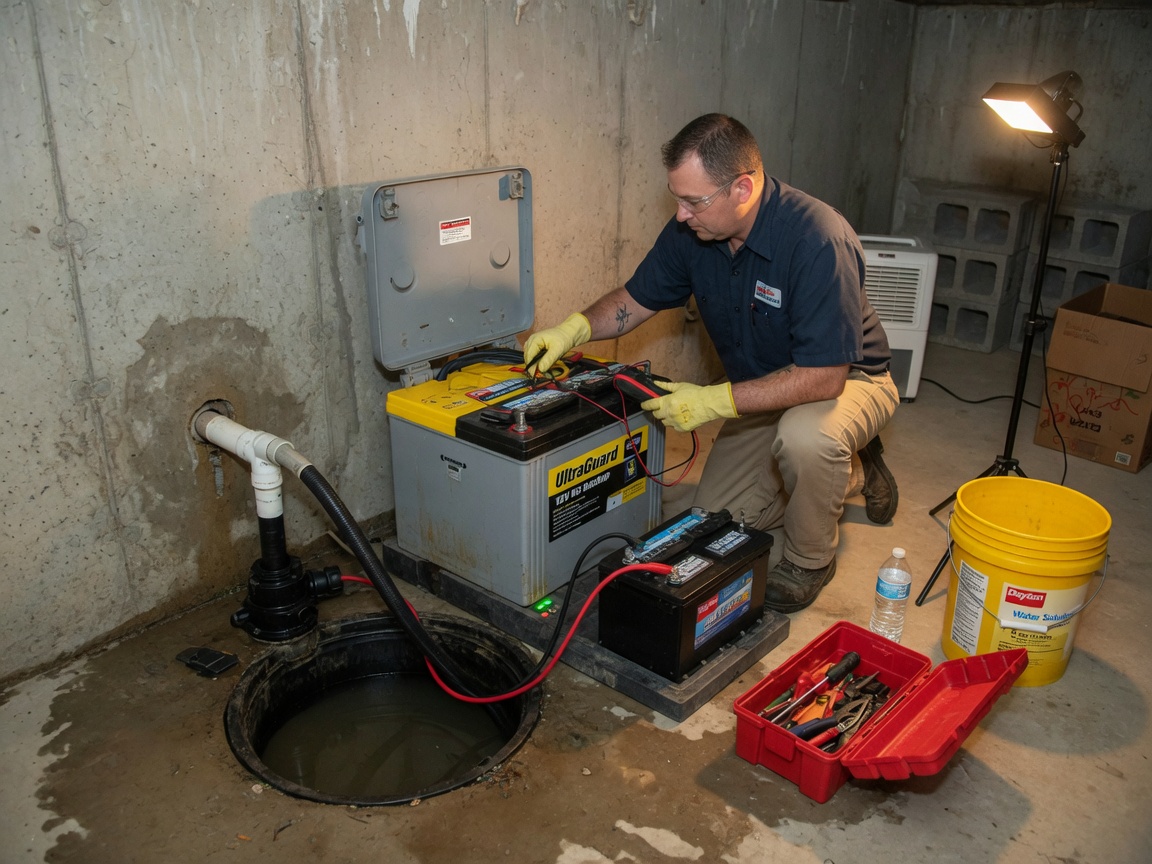
A sump pump battery backup is a second pump, mounted in the same pit, powered by its own deep-cycle battery. When the power goes out or the primary pump fails, the backup detects the rising water and takes over automatically. It is the only thing standing between a Dayton basement and several inches of water during a storm outage.
The reason this matters in Dayton specifically: our heaviest rainfall arrives with summer thunderstorms, and thunderstorms are exactly what bring down power lines across Montgomery County. The hours when your pump is most needed are the hours it is most likely to be unpowered. A primary pump with no backup is not protection — it is protection that switches off at the worst possible moment.
Battery backup vs. water-powered backup
There are two ways to back up a sump pump, and the right one depends on your plumbing. A battery backup runs on a deep-cycle battery and works in any home, but has a finite runtime — typically 8 to 12 hours of intermittent pumping, shorter if water is pouring in. A water-powered backup runs on municipal water pressure and never runs out, but requires city water (not a well) and uses a few gallons of fresh water for every gallon it removes. For most Dayton homes on city water with finished basements, we recommend the battery system, and we will tell you honestly if your setup suits the water-powered option better.
How we size the battery
Sizing is where most backup installations go wrong. A battery rated for a dry-season trickle will not last an hour against spring groundwater. We measure your pump's actual amp draw, estimate your pit's inflow rate during heavy rain, and size the amp-hour rating against real Montgomery County outage durations rather than a generic figure from the box. Oversizing the battery costs a little more up front and is almost always worth it.
What a correct installation includes
The backup pump mounts at a slightly higher float level than the primary, so the primary always does the routine work and the backup only engages when water rises past normal. The charger stays plugged into a dedicated circuit and trickle-maintains the battery between uses. The discharge ties into the existing line through its own check valve — without that second check valve, water discharged by one pump runs back down and triggers the other, and both pumps cycle themselves to death. We also install a high-water alarm that runs off the same battery, so you get an audible warning even in a blackout.
Technician insight
The failure we see most often is a backup system that was installed correctly five years ago and has quietly been dead for two of them. The charger light stays green because the charger is working — but the battery underneath it no longer holds a usable charge. Nobody finds out until the power drops during a storm and the backup turns over twice and quits. A green light is not a working backup; a load test is. Test yours under simulated outage twice a year, and assume the battery needs replacing on a schedule rather than when it fails.
Nine-Hour Outage, Dry Basement
A storm took down a line and left a home without power for nine hours, overnight, during steady rain. The primary pump was dead the moment the power dropped. The battery backup we had installed the previous spring started on its own, cycled through the night, and the homeowner woke to a dry floor and a battery at 40 percent. That is the whole value of the system in one night — it works while you are asleep and unaware.
Sump Pump Battery Backup Services We Offer
✓Sump Pump Battery Backup Installation
Full installation of a battery backup pump alongside your existing primary unit — pump, battery, charger, check valve and discharge tie-in.
✓Battery Replacement
Deep-cycle batteries lose meaningful capacity after three to five years, often while the charger still shows green. We test capacity under load and replace when it drops.
✓Backup System Testing & Maintenance
Annual simulated-outage test to confirm the backup actually starts, the charger is holding, and the float has free travel.
✓Water-Powered Backup Installation
For homes on city water that want unlimited backup runtime with no battery to maintain.
✓Dual Pump Upgrade
A second primary pump plus battery backup for basements with high groundwater inflow where one pump cannot keep pace during heavy rain.
✓High-Water Alarm Integration
A battery-powered alarm that sounds when water rises past the backup float — so you know the backup is working before you find out the hard way.
Sump Pump Battery Backup Cost in Dayton, OH
| Service | Typical Range | What Affects It |
|---|---|---|
| Sump Pump Battery Backup Installation | $650–$1,100 | Varies with battery capacity and whether the pit needs widening. |
| Battery Replacement | $180–$320 | Depends on the amp-hour rating your inflow rate requires. |
| Water-Powered Backup Installation | $900–$1,500 | Requires city water supply; includes backflow prevention. |
| Dual-Pump Backup Upgrade | $1,400–$2,100 | Moves with second pump horsepower and new discharge routing. |
| Annual Backup System Test | $95–$145 | Charger output, battery load test, float adjustment and line flush. |
Ranges are typical for Dayton, OH and confirmed with an exact written quote before any work starts.
How it works
- 1
1. Pit and Power Assessment
We check whether your pit has room for a second pump, measure your primary pump's draw, and confirm there is a suitable dedicated circuit for the charger. Some older Dayton pits need a wider liner before a backup will fit properly.
- 2
2. Sizing and Options
You get battery and water-powered options with honest runtime figures and prices for each, sized to your pit's actual inflow rather than a generic estimate.
- 3
3. Installation
Backup pump set above the primary float level, battery and charger mounted clear of the floor, separate check valve fitted, discharge tied in, alarm installed.
- 4
4. Simulated Outage Test
We kill power at the breaker, fill the pit, and watch the backup take over and clear it — start to finish, while you watch. Then we show you how to run that same test yourself twice a year.
Pricing
Upfront written quote after on-site inspection of pit depth, inflow rate and discharge options.