
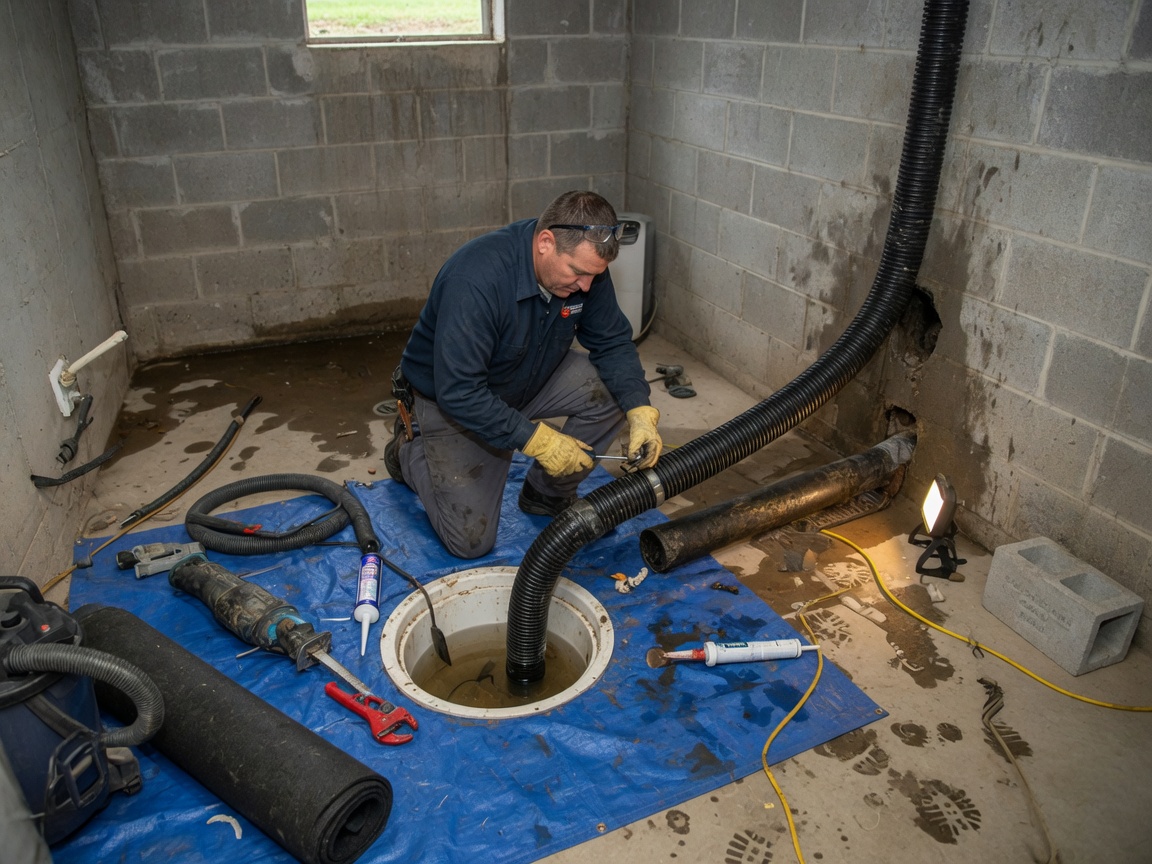
In Dayton's older housing stock, especially brick and frame homes built before 1950 in the Oregon District and South Park, sump pump discharge lines often run through shallow trenches or along foundations where clay-heavy soils hold water. Cold winters cause standing water in these lines to freeze and split PVC or corrode galvanized pipe, sending water back into the basin during thaws. Proper repair requires excavating to the correct depth below the frost line and using schedule 40 PVC with glued joints rather than compression fittings that fail under pressure from spring rains.
Heavy summer storms common to the humid continental climate can overwhelm short or clogged discharge runs that empty too close to the foundation. Many University Row and Downtown Dayton properties have shared drainage easements or tight lot lines that force discharge lines to run longer distances to reach a daylight outlet or storm sewer connection. Technicians must verify local Montgomery County grading rules before extending lines to avoid directing water onto neighboring lots in Kettering or Beavercreek.
Edge cases include discharge lines that tie into old clay tiles or that have settled due to soil movement around Carillon Historical Park area homes. When a line collapses underground, water backs up and trips the float switch repeatedly, shortening pump life. Replacement involves camera inspection first to map the exact failure point before any digging begins.
The three ways a discharge line fails
Freezing. The pump runs, pushes water into a line blocked by ice, and the water returns to the pit. The pump then cycles continuously against a closed pipe until the motor burns out. This is the most common Dayton winter failure and it is caused by shallow burial, wrong slope, or an outlet that sits in a snow drift.
Clogging. Sediment, iron bacteria and tree roots narrow the line gradually. The symptom is a pump that takes longer and longer to clear the pit, then starts short-cycling.
Collapse. Older runs tied into clay tile, or any line crossing a driveway, eventually crush under load or soil movement. Water backs up, the float trips repeatedly, and the pump dies young. A camera inspection finds the exact point before anyone digs.
Why discharge problems kill pumps
It is worth being blunt about the stakes. A blocked discharge line does not just stop water leaving — it makes the pump re-pump the same water endlessly. A motor rated for a decade of normal cycling can fail in a single winter against a frozen line. When we are called out for a dead pump, the discharge line is the cause often enough that we check it before quoting a replacement. Replacing the pump without fixing the line means replacing the pump again.
Where the water has to go
The outlet needs to be at least ten feet from the foundation, on ground that slopes away from the house. Discharging too close simply recycles the same water back through the soil into your pit — the pump runs forever and you wonder why. Discharging onto a neighbour's lot creates a problem you do not want, and Montgomery County expects discharge not to be directed onto adjacent property. Sump discharge also must not tie into a sanitary sewer line. Where lots are tight, the options are a longer run to a curb or storm connection, or a dry well — we will lay out what is possible on your lot.
Technician insight
In Dayton, the thing that catches most people out with Sump Pump Discharge and Drainage Repair is shallow burial depth on older homes in South Park and the Oregon District. Lines installed only a foot deep freeze solid every winter, split, and send water right back into the basement during the first thaw. We always check frost-line depth on every job instead of assuming the old pipe was put in correctly.
Collapsed Discharge Line in South Park
A homeowner in South Park noticed water returning to the basin after heavy rain. Camera inspection revealed a crushed clay tile section under the driveway. We replaced the run with schedule 40 PVC buried below frost line and extended the outlet to the curb. The sump now discharges properly without recirculation.
Sump Pump Discharge Line Repair Services We Offer
✓Discharge Pipe Replacement
Remove failed or frozen discharge lines and install new schedule 40 PVC runs from the sump basin to an approved outlet point.
✓Drainage Line Extensions
Extend short discharge pipes to carry water at least 10 feet from the foundation or to a street curb in dense lots found in South Park and the Oregon District.
✓Frozen Discharge Line Repair
Thaw and replace sections of discharge pipe damaged by winter freezes common in Montgomery County, then add insulation or deeper burial where needed.
✓Underground Drainage Troubleshooting
Use camera inspection to locate collapsed or clogged sections of buried discharge lines before excavation in older University Row homes.
✓Sump Outlet Basin Connection Repair
Re-seal and reinforce the connection where the discharge pipe exits the sump basin to stop leaks that re-circulate water.
Sump Pump Discharge Line Repair Cost in Dayton, OH
| Service | Typical Range | What Affects It |
|---|---|---|
| Discharge Pipe Replacement (short accessible run) | $250–$550 | Price rises with depth below frost line and proximity to foundation plantings. |
| Drainage Line Extension | $300–$700 | Longer runs to street or daylight outlet increase cost; Montgomery County grading rules may apply. |
| Frozen Line Repair and Insulation | $200–$450 | Includes thawing, section replacement, and added burial depth or insulation. |
| Camera Inspection and Diagnosis | $125–$225 | Often credited toward repair if work is approved same day. |
Ranges are typical for Dayton, OH and confirmed with an exact written quote before any work starts.
How it works
- 1
Site Assessment
Inspect the existing discharge route, measure distance to outlet, and check for frost damage or soil settlement around the foundation.
- 2
Line Mapping
Run a camera through the pipe to identify collapse points or blockages before any digging starts.
- 3
Excavation and Removal
Dig to the failure point using hand tools near foundations, remove old pipe, and prepare the trench to proper depth.
- 4
New Installation and Testing
Install new PVC with correct slope, backfill, and run the pump through multiple cycles to confirm flow away from the house.
Pricing
Most discharge and drainage repairs fall between a few hundred dollars for accessible line fixes and higher when excavation or longer runs are required.