
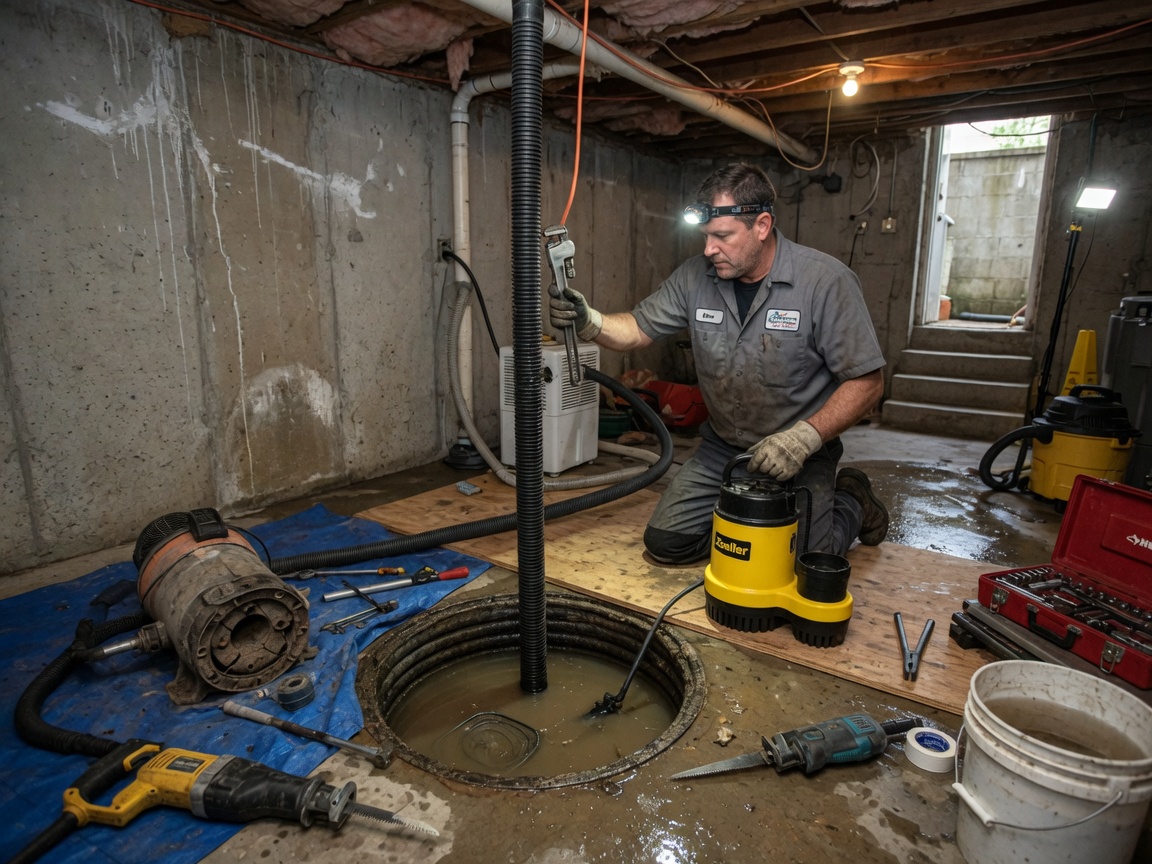
Sump pumps have a service life of roughly 7 to 10 years. Replacement is not a failure of maintenance — it is the expected end of a mechanical part that runs in water. The question is rarely whether to replace, but whether to replace now on your schedule or later, during a storm, at emergency rates with water on the floor.
When replacement beats repair
There is a straightforward test. If the motor itself has failed — it hums without pumping, trips the breaker, smells burnt, or does nothing at all — replacement is almost always the better value, because a rebuilt motor in an aging housing fails again. If the pump is over eight years old, replace it even if the current fault is minor; you will be back in the pit within a season or two. If the pump is under five years old and the motor runs, the fault is usually the float switch, check valve or a clogged impeller, and repair is the right call. We quote both ways and tell you which one we would choose.
Sizing the replacement properly
The most common mistake in a replacement is fitting whatever horsepower came out. Pump capacity should match your pit's actual inflow rate, not the previous owner's guess. A 1/3 HP pump is adequate for most Dayton basements with moderate groundwater; 1/2 HP suits homes with high water tables, deeper basements or long vertical discharge runs. Oversizing causes its own problem — a pump too powerful for the pit empties it in seconds and short-cycles, which wears the motor faster than steady running. We measure inflow during the visit and size from that.
Cast iron vs. plastic housings
Cast iron pumps cost more and last longer. The housing dissipates heat into the surrounding water, which keeps the motor cooler and extends life meaningfully in basements where the pump runs frequently. Thermoplastic pumps are lighter and cheaper and are perfectly adequate in a pit that only runs during spring rains. If your pump cycles year-round, cast iron pays for itself on the next replacement interval.
What we check while the pit is open
A replacement is the only cheap opportunity to inspect everything else. With the old pump out we check the basin for cracks and adequate depth, the check valve (a failed one lets discharged water run straight back into the pit, doubling your cycle count), the discharge line for clogs, bad slope or frozen sections, and the circuit to confirm it is a dedicated GFCI outlet that can carry the new motor without tripping. Dealing with any of these during the replacement costs a fraction of coming back for them separately.
Technician insight
The detail that shortens more Dayton sump pump lives than anything else is the pump sitting directly on loose gravel at the bottom of the pit. Every cycle pulls small stones and grit toward the intake, the impeller grinds, and a pump rated for a decade is finished in five years. A new pump should sit level on a solid base — a brick or a proper stand — with clearance underneath. It costs nothing at installation and it is the single cheapest thing you can do to make the replacement last.
Twelve-Year-Old Pump, Replaced Before It Failed
A homeowner called because their pump had started cycling more often than usual. It still worked. It was twelve years old, thermoplastic, sitting on gravel, with a check valve that had partially failed and was recycling water back into the pit. We replaced it with a cast iron 1/2 HP unit on a solid base with a new check valve. Total cost was ordinary daytime pricing — not the emergency call it would have been six weeks later.
Sump Pump Replacement Services We Offer
✓Primary Sump Pump Replacement
Failed unit removed and a correctly sized new primary pump installed, with the pit, check valve and discharge inspected while access is open.
✓Replacement with Battery Backup
New primary pump plus a battery backup unit installed together — the cheapest time to add backup protection is during a replacement.
✓Sump Basin & Lid Replacement
Cracked, shallow or unsealed basins replaced with a deeper sealed liner. A sealed lid also cuts basement humidity and radon entry.
✓Discharge Line & Check Valve Replacement
Re-routing or replacing discharge piping with correct slope, a new check valve, and an outlet that carries water well clear of the foundation.
✓Cast Iron Pump Upgrade
Upgrading from a thermoplastic to a cast iron housing for basements where the pump runs frequently year-round.
✓High-Water Alarm Installation
An audible alarm fitted during replacement so the next failure announces itself before water reaches the floor.
Sump Pump Replacement Cost in Dayton, OH
| Service | Typical Range | What Affects It |
|---|---|---|
| Standard Primary Pump Replacement | $850–$1,450 | Thermoplastic or cast iron, 1/3 to 1/2 HP, including new check valve. |
| Replacement With Battery Backup | $1,400–$2,200 | Includes backup pump, deep-cycle battery and charger. |
| Discharge Line & Check Valve Only | $350–$650 | Common add-on where lines froze or sloped back toward the house. |
| Basin & Lid Replacement | $400–$750 | Needed where the original basin is cracked or too shallow for a modern pump. |
| Cast Iron Upgrade (vs. thermoplastic) | +$150–$300 | Worth it where the pump cycles year-round rather than seasonally. |
Ranges are typical for Dayton, OH and confirmed with an exact written quote before any work starts.
How it works
- 1
1. Assessment and Honest Recommendation
We inspect the pump, basin, discharge route and circuit, and measure the pit's inflow rate. You get a repair price and a replacement price side by side, with our recommendation and the reasoning behind it.
- 2
2. Removal and Pit Inspection
Power disconnected at the breaker, old unit lifted out, pit cleared of sediment and gravel, basin walls and floor checked for cracks before anything new goes in.
- 3
3. Installation
New pump set level on a solid base — never directly on loose gravel, which draws debris into the intake — discharge connected with correct slope and a new check valve, lid sealed, circuit tested under load.
- 4
4. Cycle Test and Walkthrough
We fill the pit and run several full cycles, confirm the float has free travel and the discharge carries water well away from the foundation, then show you where the shutoff is and how to self-test.
Pricing
Written quote on site after inspection. Price depends on pump capacity, housing material, and whether the basin or discharge line also needs work.